Can You Run the SaaS Playbook on the Factory Floor?
- David Rogers
- 2026-06-15
Why does the classic SaaS go-to-market playbook break when your product has to run on a factory floor before it can prove value?
Trista Li at Deploy 95 just published a sharp analysis of 40+ industrial computer vision companies, from pure SaaS platforms like Roboflow to deeply integrated hardware plays like Cognex and Instrumental. She mapped them across five tiers based on how much performance depends on the customer’s physical environment versus the product itself.
A few findings that actually matter if you’re evaluating, buying, investing in, or building this technology:
- Proof only exists after deployment. Demos and benchmarks work for browser-based SaaS. They don’t close deals for systems bolted onto production lines. Performance shifts with lighting, part geometry, surface conditions, and factory-specific variables that no simulation fully captures. The cost of getting it wrong is too high to unwind.
- Winners go narrow early, not broad. The companies that scaled didn’t pitch “works everywhere.” They started deep in one vertical (electronics PCBA inspection, pipe welding, semiconductor, etc.) and let real deployments shape the product. The more hardware-embedded the solution, the narrower the initial focus — and the faster expertise compounds.
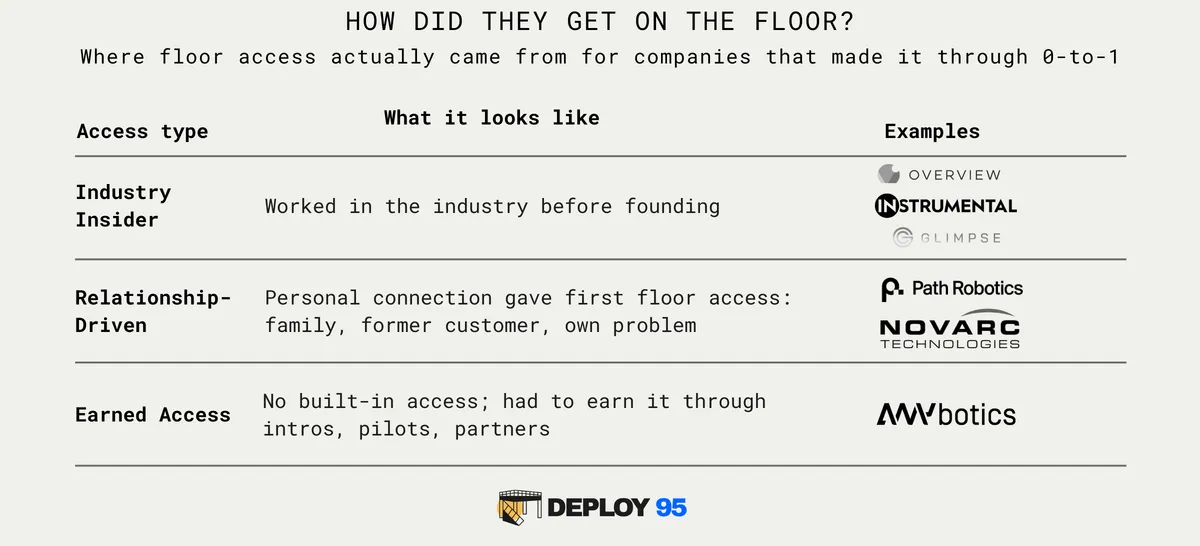
- First deployments almost always come from founder experience, not cold outreach. Floor access and trust are the real bottlenecks. Nearly every successful 0-to-1 deployment traced back to the team’s prior time on factory floors (ex-Apple, ex-Tesla, etc.), not clever messaging or outbound campaigns.
- Zebra paid $875M for Matrox not just for the tech. They were buying 46 years of accumulated application knowledge: integrator relationships, deployment playbooks, and failure-mode libraries that are extremely hard to replicate from scratch.
Trista is sharing her full research dataset exclusively with EI readers, a live spreadsheet mapping all 40+ companies across the five tiers, with funding, GTM motions, marketing claims, and vertical concentration. Whether you’re evaluating vendors, investing in the space, or building industrial AI, it’s one of the most practical references available right now.