NVIDIA B200 Compute Pricing: Dec 31, 2026 Prediction Market & Spot Analysis
- David Rogers
- Technology Prediction Markets
- 2026-08-20
NEED TO KNOW
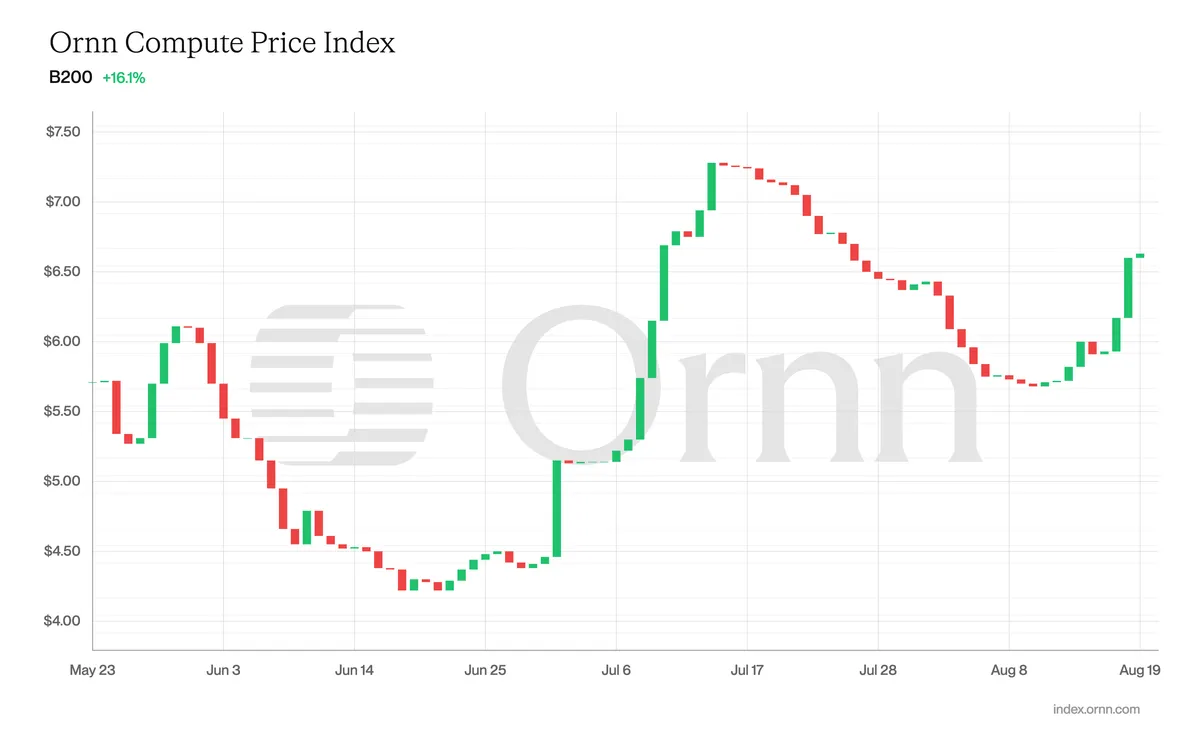
- Current Baseline Spot Rate: NVIDIA B200 compute trades at $6.63/hr on the Ornn spot index, recovering from an early-summer low near $4.30/hr.
- Prediction Market Distribution: Robinhood event contracts project an implied median between $7.50 and $8.00/hr by Dec 31, 2026, with Above $7.37 priced at 73¢, Above $7.97 at 49¢, and Above $13.07 down to 11¢.
- Deflationary Floor Pressures (< $6.00/hr): Factors driving compute below $6 include TSMC CoWoS-L capacity packaging expansion, internal hyperscaler migration to custom silicon (Google TPU, AWS Trainium), and inference optimizations like 4-bit KV caching.
- Scarcity Surge Catalysts (> $13.07/hr): Tail-risk surges above $13 require severe TSMC/HBM3e yield halts, sovereign AI cornering tier-1 DGX supplies, or data center energization delays on high-density liquid-cooled racks.
- Base Equilibrium Target: The consensus price channel for secondary B200 compute by year-end 2026 settles in the $7.20 to $8.10/hr range, sustained by hardware amortization baselines and continuous reasoning-tier inference workloads.
NVIDIA B200 spot compute pricing on secondary market indexes trades at $6.63 per hour, rebounding from early summer lows near $4.30 per hour /Ornn/. Robinhood prediction order books reflect a more balanced sentiment: contracts trade at 73 cents for prices above $7.37, 60 cents above $7.67, 49 cents above $7.97, and just 11 cents above $13.07 /Robinhood/.
The market hourly price is framed as:
- Base Hardware & Operating Floor: ~$3.80 – $4.50 / hr (based on an amortized ~$300k–$400k HGX chassis over 3–4 years at ~80% utilization plus base datacenter power).
- Current Spot Baseline (Ornn): $6.63 / hr (reflecting a moderate ~$2.00–$2.50 scarcity margin).
| Scenario | Modeled Price Target | Probability Weight (Robinhood) | Primary Market Drivers |
|---|---|---|---|
| Bear Breakdown (< $6.00) | $4.20 – $5.80 / hr | ~27% (Implied by 100% − 73¢ at $7.37) | • CoWoS packaging glut & volume deliveries. • Internal enterprise migration to TPU/Trainium. • Distillation/quantization reducing per-token GPU demand. • Mega-campus grid energizations relieving power premiums. |
| Base Case Equilibrium ($6.00 – $10.00) | $7.20 – $8.10 / hr | ~60% (Centered at $7.67–$7.97 bracket) | • Steady demand growth balanced by ongoing hardware shipments. • Liquid cooling infrastructure constraints keep floor firm. • Agentic fine-tuning absorbs new hardware capacity smoothly. |
| Bull Scarcity Surge (> $13.07) | $13.50 – $16.00 / hr | ~11% (11¢ at $13.07) | • Dual-die CoWoS-L packaging halts or HBM3e yield crises. • Sovereign AI and tier-1 lab monopolies starving spot clouds. • Test-time compute/reasoning inference explosion. • Grid interconnection moratoria and Pacific tariff escalations. |
The lower pricing boundary sits between $4.20 and $5.80 per hour, driven by key deflationary catalysts. Rapid TSMC CoWoS-L packaging throughput increases aggregate chip supply /EI/, while hyperscalers shifting internal pre-training and reasoning pipelines to custom silicon like Google TPU and AWS Trainium frees up merchant allocations. Concurrently, algorithmic breakthroughs in speculative decoding /NVIDIA/, native 4-bit KV caching, and sub-30-billion parameter model distillation sharply reduce the GPU hours needed per token, and newly energized regional grid interconnections lower colocation power premiums.
The base market equilibrium centers in the $7.20 to $8.10 per hour range through the end of 2026. This range reflects steady baseline capital expenditure amortization, with hardware costs and datacenter power establishing a firm cost floor near $4.00 per hour. Ongoing demand from frontier model post-training and high-bandwidth agentic inference steadily absorbs new rack-scale deliveries without causing severe market oversupply or unmanageable capacity backlogs.
The upper pricing tail above $13.07 per hour represents a low-probability scenario requiring acute hardware and infrastructure bottlenecks. Severe dual-die packaging halts or HBM3e yield regressions at suppliers like TSMC and SK Hynix would drastically choke new deliveries. If sovereign artificial intelligence programs and top-tier frontier laboratories simultaneously absorb nearly all enterprise DGX allocations, spot market availability would dry up, compounded by regional grid interconnection delays that leave unpowered liquid-cooled racks unable to enter service.
Ultimately, prediction markets are pricing neither a catastrophic supply collapse nor a commoditized race to the bottom. Instead, the contracts show strong support around the $7.50 to $8.00 per hour median, treating the NVIDIA B200 /NVIDIA/ as a valuable, steadily utilized enterprise asset rather than an unconstrained commodity.
Disclaimer: All forecasts, probability models, and price target estimates are independent projections for educational and research purposes only. Prediction markets carry financial risk and high volatility. This is not investment or financial advice; participate at your own risk.