Why Prediction Markets Are Bidding Up NVIDIA H200 Compute Prices Through 2026
- David Rogers
- Technology Prediction Markets
- 2026-08-19
NEED TO KNOW
- Prediction Market Odds: Prediction market contracts on Robinhood price a 79% likelihood that NVIDIA H200 compute rates exceed $5.79/hr before December 31, 2026.
- Spot Price Recovery: On-demand H200 pricing on the Ornn index recovered to $5.11/hr in August 2026 after dropping to a $3.00/hr summer low.
- Memory Architecture Moat: Technical architecture moats—specifically 141GB HBM3e memory and 4.8 TB/s bandwidth—maintain strong demand for H200 in large-context and reasoning workloads.
- Rubin Validation Delays: Supply chain adjustments, including Rubin architecture validation delays and export controls, keep high-end Hopper clusters active despite Blackwell’s 70%+ market share.
- Datacenter Power Constraints: Datacenter power interconnect bottlenecks restrict physical expansion, preserving a sustained utilization premium on existing cloud GPU capacity.
- Analytical Forecast Band: Base analytical modeling projects fourth-quarter 2026 peak spot rates between $5.80 and $6.45/hr.
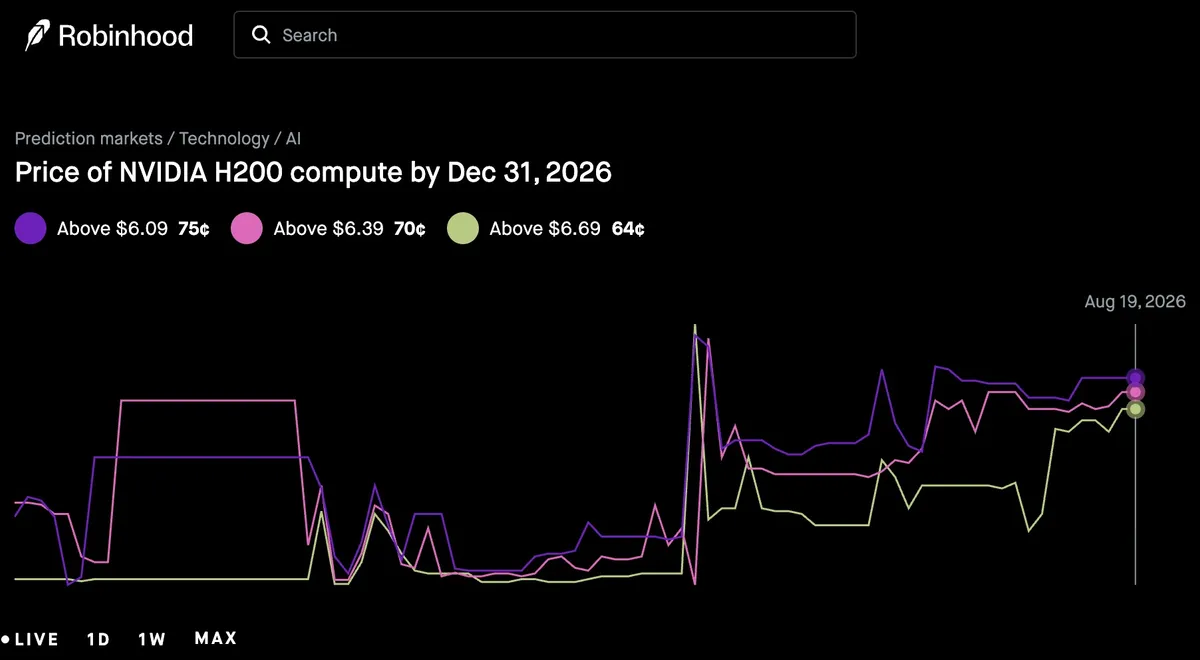
Robinhood prediction markets show strong confidence that NVIDIA H200 compute rental prices will rise before December 31, 2026. Event contracts price the probability of hourly rates exceeding $5.79 at 79%, exceeding $6.09 at 75%, and exceeding $6.39 at 70%. The underlying Ornn index currently tracks H200 spot instances at $5.11 per hour (Ornn), recovering from a mid-summer low of $3.00 per hour. Because the market resolves based on the index reaching or exceeding these strike thresholds before expiration, traders are betting that price volatility and peak fourth-quarter demand will lift rates past $5.79.
| Model Component / Factor | Mechanism & Directional Impact | Model Adjustment ($/hr) |
|---|---|---|
| Current Ornn Baseline Price | Spot index benchmark as of mid-August 2026. | $5.11 |
| Model Architecture Shift (MoE & Reasoning) | High demand for 141GB HBM3e capacity and 4.8 TB/s memory bandwidth to serve long-context and inference workloads. | +$0.35 to +$0.50 |
| Rubin Platform Delays | HBM4 and CX9 networking validation delays push Rubin deployments to 2027, preventing early decommissioning of Hopper fleets. | +$0.25 to +$0.35 |
| Export Controls & Global Tariffs | Regional trade barriers and licensing curbs restrict global supply rebalancing, creating spot shortages in primary regions. | +$0.15 to +$0.25 |
| Datacenter Power & Grid Limits | Multi-year interconnection queues prevent new high-density rack buildouts, sustaining a premium on live H200 nodes. | +$0.40 to +$0.60 |
| Q4 Seasonal Volatility & Capex Surge | End-of-year enterprise budget flushes, frontier model training pushes, and historical holiday demand spikes. | +$0.30 to +$0.45 |
| Blackwell Market Cannibalization | Blackwell expanding to >70% of high-end shipments exerts competitive price deflation on earlier generation compute. | -$0.50 to -$0.80 |
| Alternative Silicon Substitution (ASICs/LPUs) | In-house hyperscaler accelerators (TPU v6, Trainium 2) and LPUs absorb baseline token inference. | -$0.25 to -$0.40 |
Hardware specifications provide a strong demand floor for the H200 architecture /NVIDIA/. Equipped with 141 GB of high-bandwidth memory (HBM3e) and 4.8 TB/s of bandwidth, the H200 serves as an efficient platform for large-context models, mixture-of-experts architectures, and intensive inference workloads. These memory-intensive tasks prevent older Hopper infrastructure from experiencing rapid obsolescence, allowing the hardware to retain value even as enterprise buyers integrate Blackwell systems.
Supply chain dynamics reinforce this pricing support across the market. TrendForce reported back in April that delays in NVIDIA’s next-generation Rubin platform, caused by HBM4 validation challenges and CX9 networking transitions, have shifted high-end hardware timelines /Jukan on X/. While Blackwell is projected to capture over 70% of shipments, Hopper capacity will remain active rather than being retired early. Furthermore, geopolitical export controls and trade tariffs restrict the global reallocation of high-end GPUs, creating localized supply tightness among Western cloud providers.
Infrastructure constraints also limit the rapid expansion of new compute clusters. Severe electric grid connection backlogs prevent datacenter operators from deploying new high-density racks quickly. Because operators cannot scale physical facilities on short notice, they must maximize the utilization of existing H200 hardware, which adds a sustained availability premium to spot market prices. Alternative compute options, including cloud custom silicon and specialized inference units, absorb baseline workloads but fail to replace high-density GPU clusters for primary model training and reasoning tasks.
Our analytical model projects that fourth-quarter demand spikes and grid delays will offset price deflation from Blackwell manufacturing volume. The base spot rate of $5.11 per hour is expected to experience upward pressure of $1.20 to $1.70 per hour from utilization surges and supply friction, against a deflationary effect of $0.50 to $0.80 per hour from newer hardware shipments. This dynamic yields an expected peak price band between $5.80 and $6.45 per hour by year-end, validating the high probabilities priced into the prediction market contracts.
Disclaimer: All forecasts, probability models, and price target estimates are independent projections for educational and research purposes only. Prediction markets carry financial risk and high volatility. This is not investment or financial advice; participate at your own risk.