Will SpaceX Reach 150 Launches in 2026? Prediction Market & Cadence Forecast
- David Rogers
- Technology Prediction Markets
- 2026-08-17
NEED TO KNOW
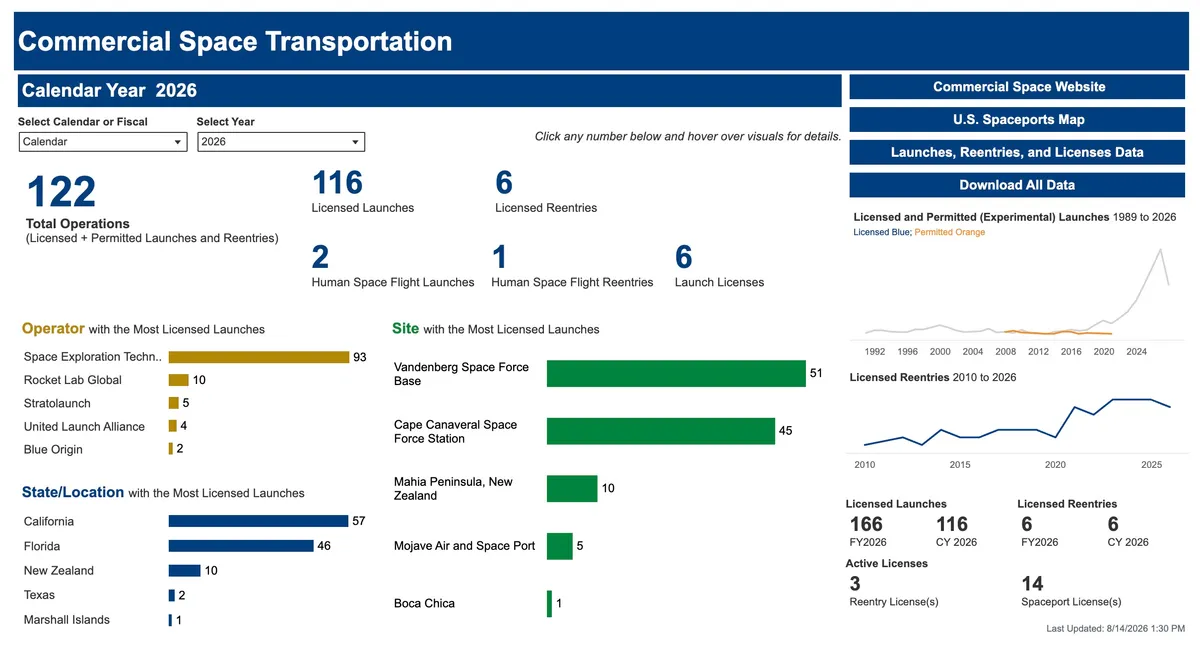
- Current Launch Pace: SpaceX completed 93 licensed launches by mid-August 2026, sustaining an operational tempo of ~12.5 flights per month (one flight every ~2.4 days).
- Projected 2026 Total: The analytical model forecasts a baseline total of ~158 launches (range: 151–163), combining dual-coast Falcon operations with 2–4 Starship test flights.
- 120+ and 140+ Strike Odds: Reaching 120 launches requires 5.9 launches per month (>99% probability), while 140 launches requires 10.3 per month (~93% probability).
- Resolution Source: Official contract settlement relies strictly on licensed commercial launch records from the Federal Aviation Administration (FAA).
Official Federal Aviation Administration records confirm that Space Exploration Technologies Corp. logged 93 licensed launches in calendar year 2026 as of the August 14 update. Across the broader commercial industry, the FAA tracked 116 total licensed launches, 6 licensed reentries, and 122 total operations for the year. With 139 days remaining in 2026, reaching the 120-launch mark requires 27 more flights, or roughly 5.9 launches per month. Clearing 140 launches demands 47 flights, or 10.3 per month, while hitting 150 requires 57 flights, translating to approximately 12.5 launches per month. Because SpaceX currently averages about 12.5 launches per month across all operational sites, baseline arithmetic projects an annual finish near 150 total missions.
To project SpaceX’s final 2026 launch tally, calibrated to FAA Commercial Launch Data through August 14, 2026 (139 days remaining) (FAA), we model launch throughput as a function of operational capacity minus friction factors:
| Model Layer / Component | Operational Parameter | Gross Output | Net Adjustment |
|---|---|---|---|
| Baseline Completed | FAA Official Record (thru Aug 14) | 93.0 launches | +93.0 |
| SLC-40 (Cape Canaveral, FL) | 1 launch / 3.8 days (139 days left) | 36.6 launches | — |
| LC-39A (Kennedy Space Center, FL) | 1 launch / 7.5 days (139 days left) | 18.5 launches | — |
| SLC-4E (Vandenberg SFB, CA) | 1 launch / 4.2 days (139 days left) | 33.1 launches | — |
| Gross Falcon Pad Capacity | Theoretical dual-coast total | 88.2 launches | — |
| Weather & ASDS Sea State Friction | Atlantic hurricane season drag (-11%) | -9.7 launches | -9.7 |
| Range & Priority Holds | DoD / NASA launch window holds (-7%) | -6.2 launches | -6.2 |
| Pad Turnaround & Maintenance | Static fire and maintenance drag (-8%) | -7.1 launches | -7.1 |
| FAA Administrative Pauses | Tail risk / mishap stay drag (-4%) | -3.5 launches | -3.5 |
| Net Remaining Falcon Output | Post-friction expected launches | — | +61.7 |
| Starship Test Flights | Boca Chica OLM-1 / OLM-2 flights | 2–4 tests | +3.0 |
| 2026 Expected Launch Total | Combined Baseline (Range: 151–163) | — | ~157.7 |
The FAA data highlights regional distribution, showing 57 launches originating from California, 46 from Florida, 2 from Texas, and 1 from Boca Chica specifically. Crossing 120 total launches maintains a modeled probability exceeding 99 percent, while the Above 140 contract trades near 93 cents. On the Robinhood prediction market, the Above 150 contract trades at 78 cents, aligning closely with our analytical baseline probability of 74 to 78 percent. Contracts for higher thresholds reflect steeper execution hurdles, with Above 160 pricing at 34 cents and Above 170 trading at 9 cents, reflecting significant downside risks from late-season weather and range constraints.
| Strike Level | Launches Needed | Required Pace | Model Probability | Market Price | Market vs. Model Alignment |
|---|---|---|---|---|---|
| Above 120 | 27 | 5.9/mo (5.1d cadence) | >99% | — | High conviction floor |
| Above 140 | 47 | 10.3/mo (3.0d cadence) | ~93% | — | Strong statistical cushion |
| Above 150 | 57 | 12.5/mo (2.4d cadence) | ~74–78% | 78¢ | Fairly priced (aligned with model) |
| Above 160 | 67 | 14.6/mo (2.1d cadence) | ~31–36% | 34¢ | Fairly priced (assumes zero weather downtime) |
| Above 170 | 77 | 16.8/mo (1.8d cadence) | ~6–9% | 9¢ | Fairly priced (requires record cadence) |
Operational capacity across primary launch sites drives this cadence, led by Vandenberg Space Force Base with 51 licensed launches and Cape Canaveral Space Force Station with 45 licensed launches to date. Between Space Launch Complex 4E in California, Space Launch Complex 40, and Launch Complex 39A in Florida, SpaceX retains a raw theoretical capacity of roughly 85 remaining Falcon missions through year-end. In addition, FAA-licensed Starship test flights from the Boca Chica spaceport in Texas contribute incrementally to the annual commercial tally.
Unavoidable operational friction historically reduces theoretical pad throughput by twenty-five to thirty percent over the final four months of the year. Peak Atlantic hurricane season creates rough offshore recovery sea states, preventing drone ship landings and causing launch delays even during clear pad weather. Furthermore, pad maintenance, static fire holds, priority DoD range reservations, and FAA administrative reviews introduce systemic drag. Factoring in these deductions leaves an expected net output of 53 to 57 Falcon launches and 2 to 4 Starship tests for the rest of the year.
The analytical forecasting model projects a final 2026 SpaceX total between 151 and 163 launches, centering on an expected baseline of ~158 missions. Prediction market positions on the 120 and 140 strike levels offer strong safety margins against adverse operational delays. Conversely, contracts predicting more than 150 launches require an uninterrupted 2.4-day cadence through the autumn weather bottleneck, making current market prices slightly aggressive relative to empirical launch risk.
Disclaimer: All forecasts, probability models, and price target estimates are independent projections for educational and research purposes only. Prediction markets carry financial risk and high volatility. This is not investment or financial advice; participate at your own risk.